
The Call of the Bugle – Part IV: The Nurses of Scutari
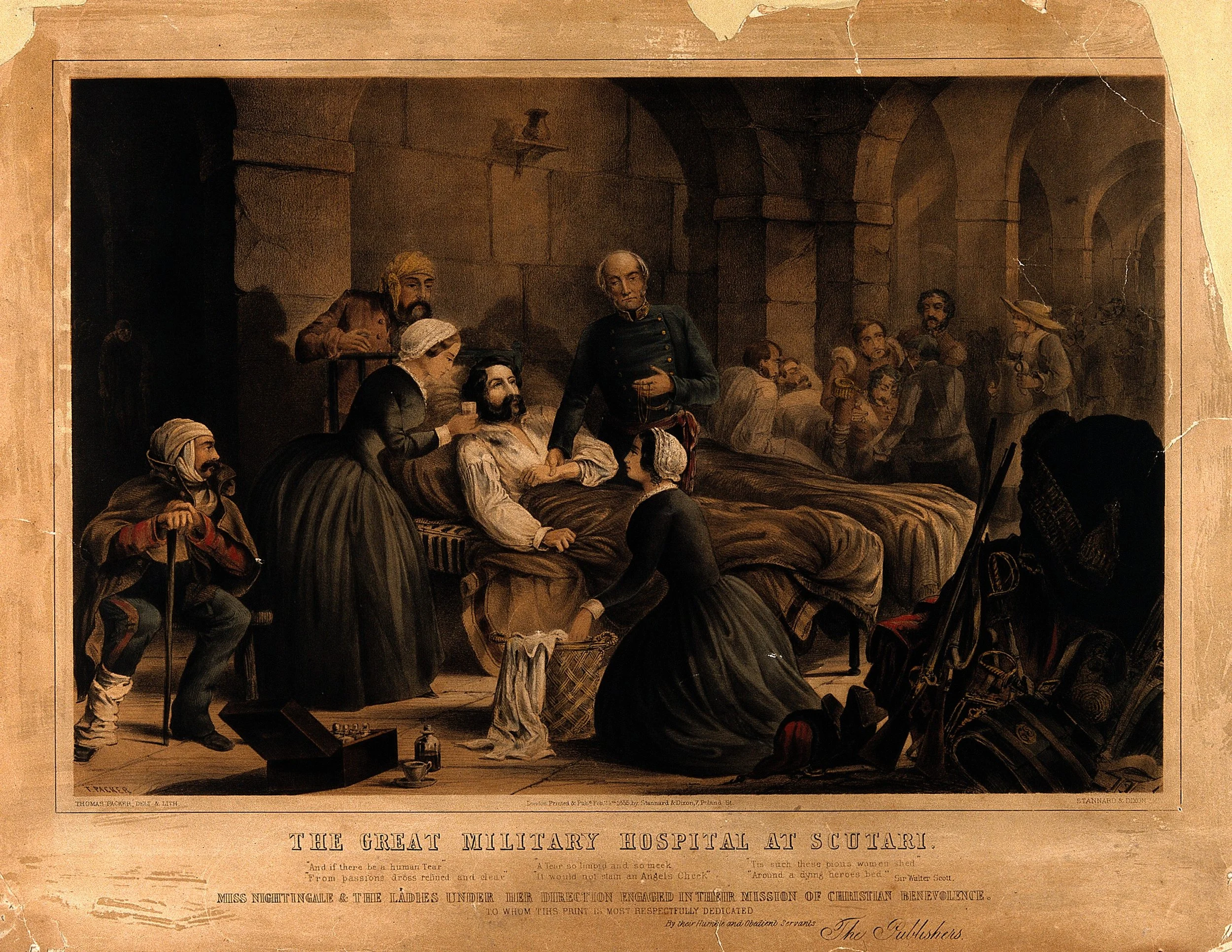
Florence Nightingale and her staff nursing a patient in the military hospital at Scutari. Coloured lithograph, c. 1855, by T. Packer after himself. Wikimedia.
I wasn’t planning to write a blog about the women who volunteered to nurse the sick and wounded in the Crimea. But one thing led to another, and I came across a letter purportedly written by a nurse at Scutari hospital.
Here it is again:
“The trumpeter that sounded the charge for Lord Cardigan is a most pitiful case. He begged that his bugle not be taken out of his sight. Cardigan spent half an hour with him, soothing him. He is lying in some plank beds and blankets. He belongs to the 17th Lancers. His name is Brittain. The sergeant of the 17th calls him Billy
and keeps telling him to pluck up and get out and blow another charge, but there was never any hope.”
The stark words moved me.
Now, there are problems with the letter: Nurse Farrell does not appear either on Nightingale’s roster of nurses or on the list of Irish nuns from the Little Sisters of Mercy. Spurious? She could have been one of the original staff. Billy was wounded in October; Nightingale arrived in December. The description sounds right. Sotheby’s vetted Billy’s claim, and that’s enough.
But it bothered me. There was something left unsaid. So I did some research.
Field hospitals at Balaclava were tents, farmhouses, or any structure that could be used; Scutari was a converted stone barracks built on the site of an earlier Janissary structure. Raw sewage flooded rotting floors. Lice, flies, and rats swarmed. Thousands of men were jammed together. One small kitchen served inedible food.
A petri dish for disease, let alone battle wounds.
Nightingale said she saw 2,000 men die in the first winter.
Nightingale’s nurses immediately cleaned the entire structure. Later, they convinced the British authorities to repair the sewage system.
The nurses then set about installing a new regime. They worked long hours, took cat naps, and dozed off at times. Discipline was strict; those who didn’t measure up were immediately sent home. They probably didn’t smile much and hardly laughed. After all, they were stepping over men lying on the floor eighteen inches apart, and they never knew who would live and who would die.
It doesn’t take too much to imagine what they sounded like:
“Wash your hands. That’s right, I said ‘wash your hands.’”
“Open that window and let’s get some sunlight in here.”
“This blanket is full of lice; take it away and wash it.”
“What do you mean ‘there’s no morphine?’ Go and find some immediately.”
But, miracle of miracles, they did it and changed the face of nursing care forever.
Before Nightingale and her crew arrived, the death rate was 40%. After months of their care, it dropped to 2%.
Scutari is now a military hospital called Selimiye Barracks. The old walls have been plastered over, and everything now gleams white and chrome. White-coated doctors and orderlies in blue surgical gowns walk about its corridors. But perhaps sometimes, when the lights are turned down at night and the staff murmurs to themselves, the old corridors may yet hear the faint echo of older voices.
Who knows?
If you ever are hospitalized and see all the nurses, orderlies, and nurses’ aides running about, look hard, and you might see the nurses of Scutari smiling at you.
So, what is the meaning of valor? Is it charging down a valley of death “all glittering and proud?” Or is it grinding away eighteen hours a day and never quitting until men stop dying?
It is both.
