
Medusa – Part I: The Woman and the Myth
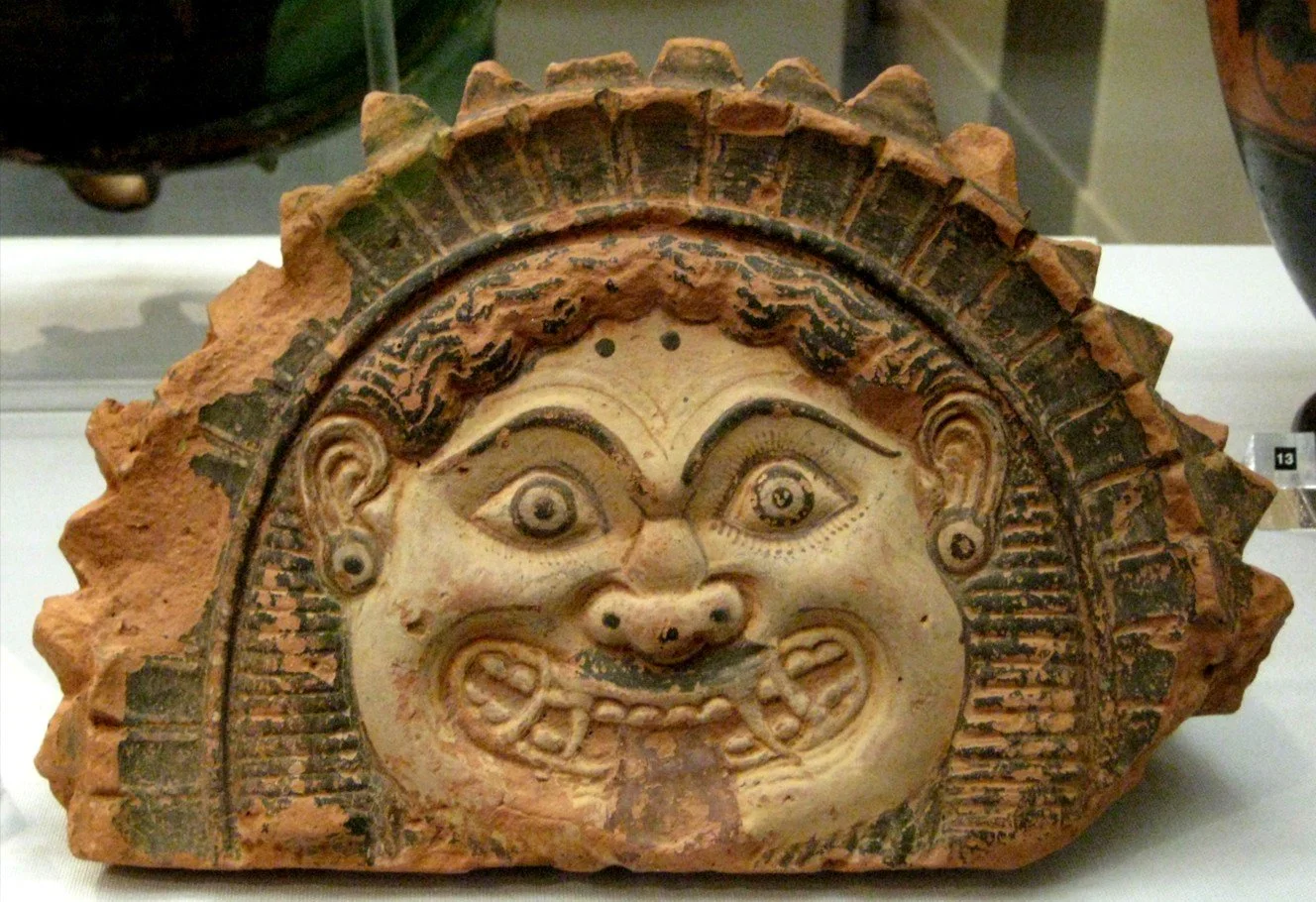
Classical Greek gorgoneion featuring the head of Medusa; fourth century BC. (Credit: Pushkin Museum, Wikipedia)
The crystal glass sparkled in a stray beam of early evening sunlight.
Thomas Pettigrew leaned back in his chair, held his cognac to the light, and peered at the pointed face surrounded by tight curls on its stem. “I’ve looked at Medusa’s face for half a century now, and she is as inscrutable as she was when Flinders and I first started out.” He sat in a green velvet chair with golden arms. The old sitting room was half shadowed in the evening light.
Pettigrew smiles, takes a sip of cognac, and says to the young reporter. “So, let me tell you a story, a very strange story. Medusa already knows it.”
And thus began the singular adventure of The Man with the Eyes of a Cat.
So who was this Medusa of the pointed face and tight curls?
In the first place, she was a gorgoneion, a talisman to ward off evil, and her origins predate written history.
In the ancient world, there were two versions of her creation. Greek accounts depict her as a Gorgon, one of three monstrous sisters, but unlike her sisters, who were gods, Medusa was a human. The Roman poet Ovid fundamentally changed this: Medusa was the most beautiful of women. Her beauty was so great that the Gods became jealous and punished her by turning her into a monster. Her wondrous hair changed from lustrous gold to a nest of hissing snakes; her visage became so hideous that anyone looking at it was turned into stone by the horror.
Details vary, but Ovid’s version has carried over the centuries: great beauty that becomes something horrible, a theme that is repeated again and again, a fascination with the dark side of beauty. Oscar Wilde dramatized it in The Picture of Dorian Gray. Hollywood does it all the time; smiling beauties suddenly become screaming monsters.
Medusa turned many men to stone. Perseus managed to kill her, but only because he used a magic shield and viewed her in its mirror. After that, Medusa has often been depicted solely as a woman’s head.
But there is a little detail missing from this mythology: Only men turned to stone; no woman was ever affected. After Sammi dies in Cleopatra, a grieving Pettigrew tells Flinders that she was the only woman who saw him as a man. All the others rejected him. Flinders replies that, yes, the arch of an eyebrow, the slight sniff with head turned away, can turn you into stone on the spot.
More about that later.
So what happened in the mists of antiquity?
We will never know.
What we do know is that the Greeks put Medusa on a wide variety of objects: shields and armor, pottery, amulets, carvings on buildings and temples. The gorgon head became a symbol of protection against evil in the classical world, a role similar to that of Ra in the pharaonic world.
Her face was all over Greece and Rome.
The 20th-century designer Versace used her head as his signature logo, the writhing snakes tamed into a stylized image. When asked why, he said that as a boy growing up in Rome, he was surrounded by her image. Indeed, Medusa is everywhere. She appears in the famous frescos at Pompeii. Roman craftsmen even put her face on the bottom of drinking vessels, a surprise for the inebriated diner.
But there is another side to Medusa. She is also the face of nature incarnate, unknowable and uncontrollable. Ancient deities had multiple aspects, mirroring the complexity of human relations, and Medusa was no exception.
The earliest Greek images portray Medusa as a figure of horror in keeping with the original myth. She has writhing snakes, bulging eyes, and a protruding tongue, chaos itself. Her distorted face was a primordial warning to humans of the danger in confronting the chaotic and destructive force of nature.
So the once beautiful woman becomes the face of nature itself. Confront nature and you, too, risk being turned to stone.
This theme has come down the ages, dramatized by Hollywood over and over, from Frankenstein to Godzilla to Jurassic World—and perhaps most famously in Herman Melville’s Moby Dick. Captain Ahab hunts the great white whale only to be destroyed by it.
The theme also sometimes shows up in unexpected places.
In the 1970s, Chiffon Margarine ran a TV ad: Mother Nature smiles and eats a slice of toast buttered with margarine. She smiles and remarks that her natural butter is the best. A narrator tells her that it’s not butter, but margarine. She turns to the camera, her face furious and snarling. “It’s not nice to fool Mother Nature.” A thunderclap and lightning bolt follow.
So when Pettigrew (or Flinders) swirls cognac and stares at the glass’s crystal face, he reminds himself of the dangerous world he is about to enter. But both Flinders and Pettigrew are driven men, driven to seek out the far pavilions, to find the horizons after the horizon.
Like the crew of the Enterprise, they seek “to go where no man has gone before.”
As Flinders puts it in The Bones of the Apostle, “Thomas, I’m bored. We need some excitement.”
Every adventurer needs a talisman. For Flinders and Pettigrew, the crystal glass is that talisman.
But Medusa changes over time. The raving monster gradually morphs into a beautiful woman, the writhing snakes become calm, the distortion disappears, and the ancient imagery is literally turned on its head. Medusa becomes the symbol of women’s resistance to patriarchal oppression and the darling of the Me Too movement.
So what is that all about?
More next time.
