
Medusa – Part II: Evolution of an Image
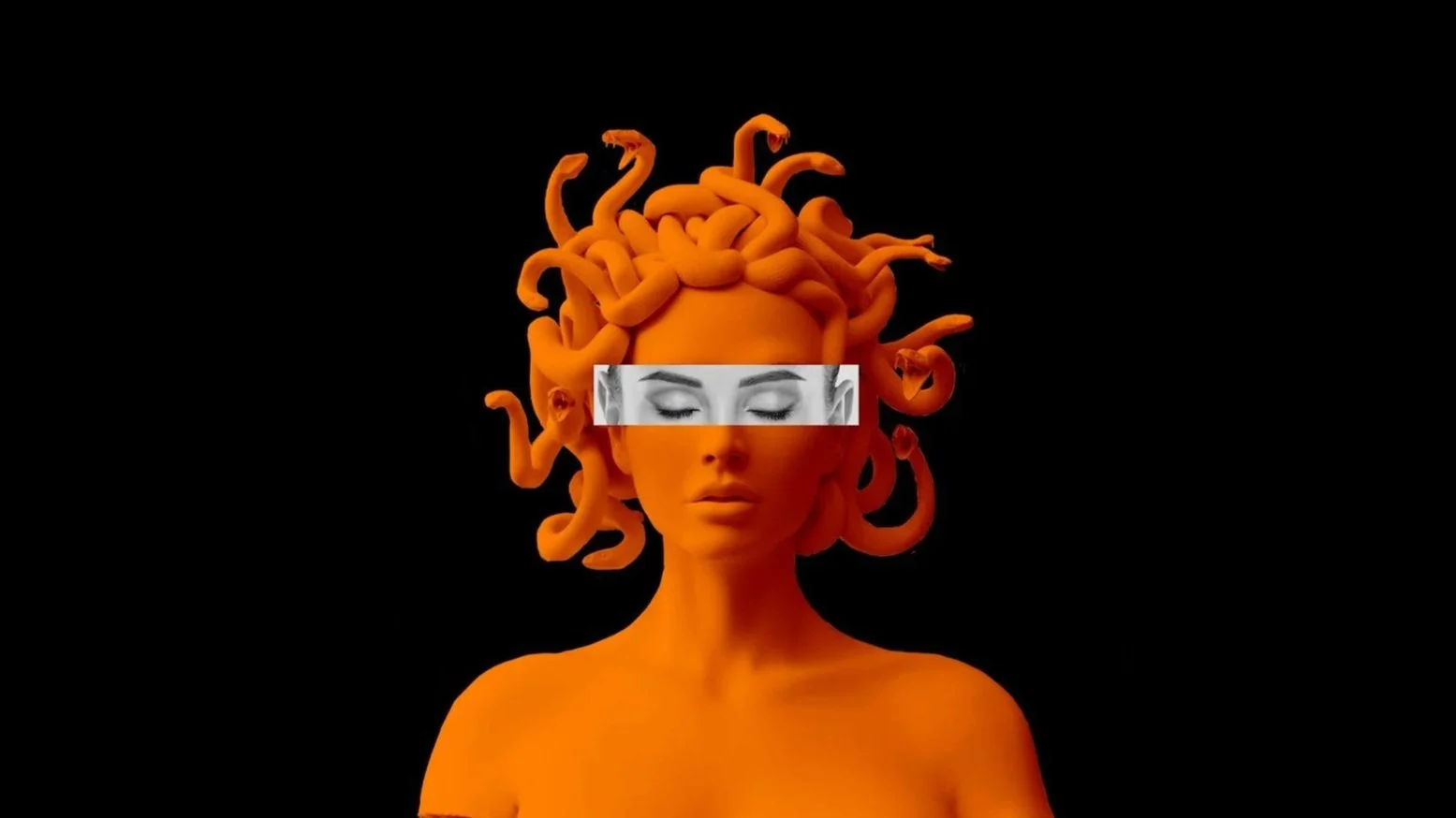
So what happened to Medusa?
Over the course of two thousand years, Medusa’s image evolved from that of a monster with tusks and a beard to that of a beautiful woman. She was a woman horribly wronged, raped by a god and then punished as the victim—but also a woman who resists, who rages and survives millennia and eventually becomes an emblem of the modern-day Me Too movement.
It was a gradual evolution. Hellenistic artists replaced her horrifying features with human attributes, and by the 1st century AD, she was portrayed as a vulnerable woman, the victim of divine punishment.
By the end of the Renaissance, she had become a beautiful but agonized and dangerous figure. Carravagio’s 16th-century painting of Medusa says it all: In the dark chiaroscuro, a woman in agony rages at her oppressors.
The generalized rage became more focused by the time of the French Revolution. Medusa and the beautiful Marianne became confused. In 1789, revolutionaries used the Marianne image to symbolize the beauty of the Revolution confronting the dark, predominantly masculine forces of the Ancient Regime. The horrified British struck back. In The Tale of Two Cities, Dickens depicts Marianne as Madame Defarge, who wears the same Phrygian cap and knits the names of nobles to be killed as she calmly watches heads rolling from the guillotine. Even Dickens, the literary heavyweight of all literary heavyweights, couldn’t reduce Medusa to the old gorgon monster.
The Medusa image morphed into the “femme falale” archetype of the late 19th-century Symbolist movement. The femme fatale is an alluring, seductive, and incredibly dangerous woman. French actress Sarah Bernhardt became the face of the femme fatale on the stage and explicitly referenced Medusa by wearing a snake bracelet designed by painter Alphonse Mucha. American actress Theda Bara became the American version in the early silents.
But what has all this got to do with a couple of very macho detectives?
Let us return for a moment to The Man with the Eyes of a Cat. Gertrude, the Times reporter, stares at her glass of cognac.
Medusa. I stared at the pointed features surrounded by tight curls. I never thought to look before, a strange glass in a strange room. A room from another time.
“This is beautiful crystal; I don’t think I’ve ever seen anything like it.”
“Flinders found it at a flea market in the East End. He snatched it up and brought it home. He said she would connect us to the eternal feminine, as does Cleopatra and ISIS, a line of power that stretches into the mists of antiquity.”
“The eternal feminine,” odd coming from the lips of such a man.
Such a man?
Indeed, such men.
Both are masters of stylized violence, bound by a rigid code of honor, and both are terribly vulnerable. With his dark hair and eyes and soft Irish brogue, Flinders is irresistible to women yet aloof because of an old tragedy—a man of tailored suits and starched cuffs well before John Wick. He quotes Cyrano as he routs harem guards. Pettigrew, a giant with hair the color of lemons in the sun, throws his assailant through a wall and then casually remarks that the Veiled One should really hire larger henchmen. When asked about his skill in Savate, Pettigrew smiles and says simply, “The idea is to dispatch your opponent without wrinkling your cuffs.”
Odd, indeed, that they should be fascinated by the eternal feminine, by the femme fatale herself. Gertrude should have looked around the flat. The evidence was all there: Cleopatra on the wall, Isis on a pedestal, and Bernhardt in the hall. If Holmes had been there, he would have chuckled and said to her, "You see, but you do not observe. The distinction is clear."
So, how did this fascination happen? Flinders and Pettigrew were clearly men out of their time—T. E. Lawrence was, as well. Psychologist John Mack describes Lawrence as a “prince of our disorder,” and maybe Flinders Petrie and Thomas Pettigrew were also princes.
Let’s have another go at Medusa next time.
Any comments?
