
Scheherazade – Part II: Who Was She?
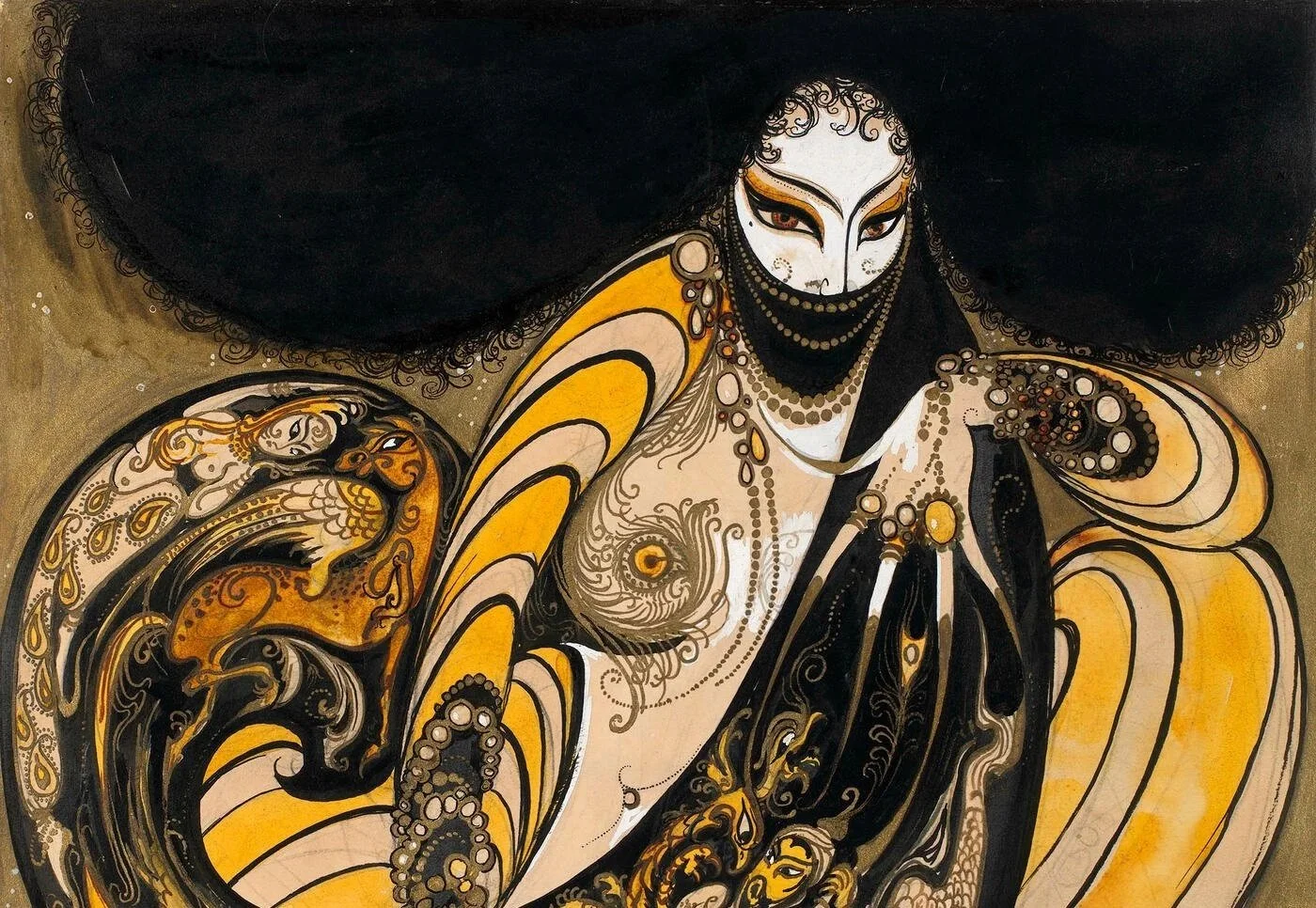
Unpublished album cover design for Nikolai Rimsky-Korsakov’s Scheherazade by Erté. Credit: MacDougall’s
Who was this woman who whispers in your ear?
Before I get started on Scheherazade, let me go back to my earlier blog about the male-female dynamic in the Arabian Nights. After I wrote it, I remembered an old black-and-white movie about Henry VIII. Henry was a real-life version of Shahriyar, who executed five of his six wives. In The Private Life of Henry VIII, wife number six, Catherine Parr (played by Elsa Lancaster), cajoles the aging Henry (Charles Laughton) and tells him stories. Henry ultimately gives up on any idea of executing her and declares, “Six wives, and the best of them's the worst.”
I first watched Private Life on an old TV in my Cairo apartment with Arabic subtitles. At the time, Egyptian TV played a lot of Laughton's films. I'm sure the film is available on TNT. If you want to see some brilliant acting by two of the world's best, take a look.
Back to Scheherazade: What did she look like?
The obvious conclusion is that she was very beautiful. As a rule, caliphs marry beautiful women (just like modern kings and princes). There are a number of fanciful orientalist portraits of her. Some, like Rimsky Korsakov's music, catch her persona. They all show her unveiled, but she probably wore a veil outside the palace. And, of course, she didn't just roam around the streets: The wife of a caliph would be accompanied by guards and probably travel in an enclosed vehicle of sorts.
Take a look at some of the paintings of her and the Nights by Maxfield Parrish; both Chagall and Erte have suites of Scheherazade paintings. You can Google them.
In Bones, when Flinders, Pettigrew, and Gazelda finally reach British Intelligence headquarters in Baghdad, Flinders looks down the cobbled street and tells Pettigrew that, if he looks hard enough, he might see Scheherazade crossing the street. He goes on to say that he could imagine the caliph trotting toward them accompanied by guards and drums, the men all dressed in Abbasid black.
Such is the power of Scheherazade's mystique.
OK, she was beautiful, but tell us more about her. She couldn't have made all those stories up; she had to get them from somewhere. The stories themselves come from a variety of sources: Arabic, Persian, and even ancient myths. Most are Abbasid in origin. For a good summary, check out Wikipedia. So how did Scheherazade get them? Burton's translation of the Nights offers a clue. He describes her as pleasant, witty, and wise, and says that she collected over a thousand stories and histories. She read both poetry and philosophy. So, she was extraordinarily literate for her time and could easily have put together a thousand tales.
In Bones, Gazelda parallels Scheherazade. Gazelda is the original bookworm who reads everything, including monographs by Flinders. She also tells outrageous jokes; Pettigrew describes her as “the Scheherazade of old Holmes jokes.” And like Scheherazade, she is very beautiful. "I can tell by your face (Flinders) that you like what you see."
But it is not all seriousness and sex.
I had some fun with the Nights: In Bones; Father Divinius, head of the British Intelligence Office hidden in the Ashmolean Library at Oxford, tries to tell Flinders the nomenclature of agent code names in the Arabian Peninsula. He explains that their names were drawn from characters in the Nights, and that Mycroft Holmes was the originator of this system, because he wanted to add a touch of class to the operation. Flinders is not impressed. Divinius patiently repeats the names, but Flinders can't get them straight:
"I will cable Princess Badroulbadour ... "
"And who... is Princess Badroulbadour?"
"Why, Gertrude Bell, of course; that is her code name."
"I suppose the Kalendar Prince is there, as well."
"No, no, no, the Kalendar Prince is in Damascus."
"And Sinbad?"
"In Basrah, where else?"
"I dread to think where Ali Baba is."
"In Hadramaut."
"Hadramaut?"
"The home of frankincense and myrrh."
"So, let me understand this... Badroulbadour is in Baghdad."
"Yes"
"The Kalendar Prince is in Damascus."
"Exactly so... "
''And Sinbad is in Hadramaut... "
"No, Sinbad is in Basrah,"
''All right, Ali Baba is in Hadramaut."
"The home of frankincense and myrrh."
"I have it, then."
Older readers will recognize the parody of the Abbott and Costello skit, "Who's on First?" And for everyone else, Google the skit, and you'll find some insanely funny dialogue performed by two masters of the art of comedy. By the way, Abbott and Costello did a picture about adventures in the Middle East: see Lost in a Harem (1944), and it includes another famous skit, "Slowly I Turned."
Where the Arabian Nights are concerned, everybody gets into the act.
