
Scheherazade – Part I: Imagination Soars
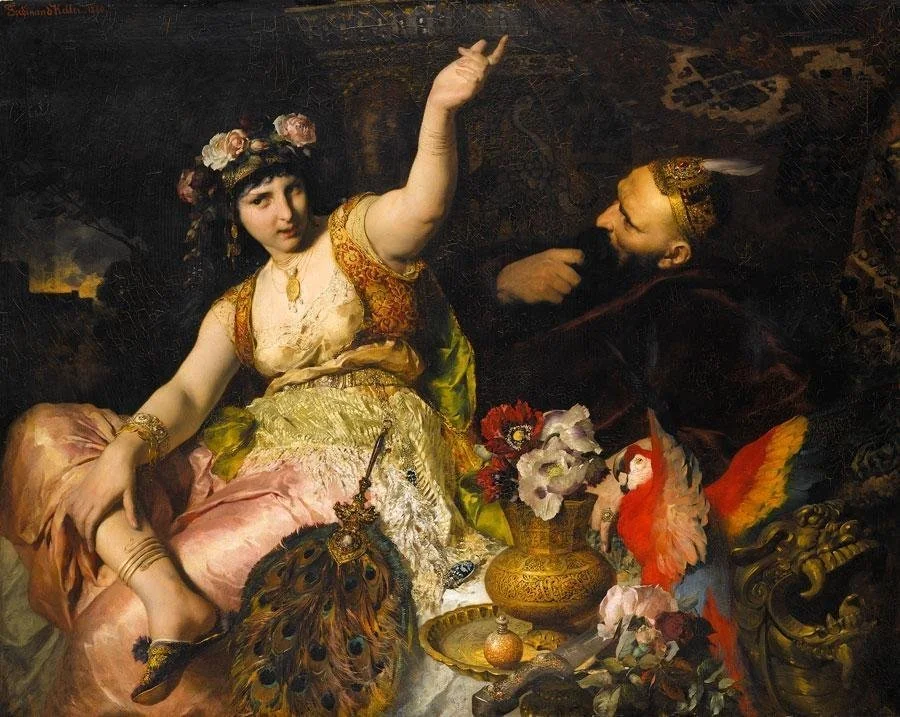
Scheherazade and Shahryar by Ferdinand Keller, 1880
The name Scheherazade percolates through Flinders and Pettigrew. Many of the scenes are set in various “Scheherazade Clubs” scattered about the Middle East. In Cleopatra, Pettigrew meets Sammi, the only real love of his life, and then watches her die in the Cairo Scheherazade Club. Decades later, The Student visits the same club and dances tango in his imagination with Samira. In Bones, Flinders and Gazelda realize that they are in love while dining at the Scheherazade Club in Baghdad.
But it is the mystery and romance of Scheherazade that drives the imagination. In Bones, the Dragoman tells Flinders that he came to Baghdad because the Abbasids had gotten into his head and that Scheherazade "whispered in his ear" and drove him to act.
The whisper of Scheherazade drives the imagination of us all
As a boy, I first heard Rimsky Korsakov's Scheherazade on scratchy 78 RPM records. When the solo violin started Scheherazade's soaring theme, I leaned close to the old record player and was transported to a world of dashing heroes, beautiful princesses, and evil villains. Nothing Hollywood could produce came close to the imaginary wonders of the Arabian Nights. The wonder of Scheherazade started when I was a boy and never stopped. Whenever I heard the silken strains of that violin, I slipped back into the romance of tenth-century Islam, with flashing scimitars, veiled ladies, gallant princes, and giant roes. (A roe is a large bird, akin to a vulture. Sinbad was carried off by a giant roe.) An escape to a world that sometimes was.
There is a historical basis for Scheherazade's tales. The Abbasid Caliphate lasted from 750 AD to 1258 AD and is considered to be the Golden Age of Islam. Caliph Harun al-Rashid is the most famous of the Abbasid caliphs, and the model for film and literature. The Abbasids made Baghdad the epicenter of science, literature, and the arts. Algebra and astronomy were created. It is no accident that many stars have Arabic names. Much of what we know today about Greek and Roman civilization comes from texts translated by Abbasid scholars.
But there was a downside: the regime was famously male chauvinist and has been heavily criticized by contemporary women's rights activists. There is a story that Flinders remembers as he looks down from the balcony of bliss onto the floor where young women would dance to catch the Caliph's eye and be chosen for the night (see the full description in The Student): Two young women were chosen to be the Caliph's companions and were forced to sit over a slow fire of rose petals until they were sufficiently perfumed.
Did I say male chauvinist? On steroids.
The Nights themselves are a collection of stories revolving around a central theme: Caliph Shahriyar, bitter because he was cuckolded by a cheating wife and convinced of the faithlessness of women, executes all the women he marries the morning after—that is, until he marries Shahrazad. Here, I use the Arabic transliterations of their names. Note the similarities in spelling; they could stand for male and female archetypes.
Get the idea?
In any event, Scheherazade tells him such wonderful stories (stopping in the middle each night), that he keeps postponing her execution for a thousand nights after their wedding and then allows her to live. The real title of the Nights is Alf Layla wa Layla, "a thousand nights and a night." This male-female dynamic runs all through the work.
Alf Layla wa Layla has been translated into just about every language in the world. The earliest is the French version done by Antoine Galland in the 18th century. The most complete was published by Richard Burton in the 1880s and is almost 20 volumes. Burton was an East India company officer, fluent in multiple languages, and assigned to investigate local brothels. His translation is filled with erotic detail, especially the endnotes. Victorian reviewers described the work as "fit only for the sewer."
Burton also translated the Kama Sutra and, when he wasn't translating, discovered the source of the Nile. He regularly fought duels with his critics. After his death, his wife destroyed most of his writings in an effort at Victorian damage control. Although often portrayed as children's stories, the tales are very much adult fiction. The title Alf Layla wa Layla means exactly what it says, and the end notes are a “how to do it” manual. When Flinders chides Gazelda in Bones for rushing through Burton's Alf Layla to get to the endnotes, he is making quite a statement.
So, who was this woman, Scheherazade? Stay tuned for my next blog post.
