
The Arabian Nights Revisited I: The Strange Case of Wendell Phillips
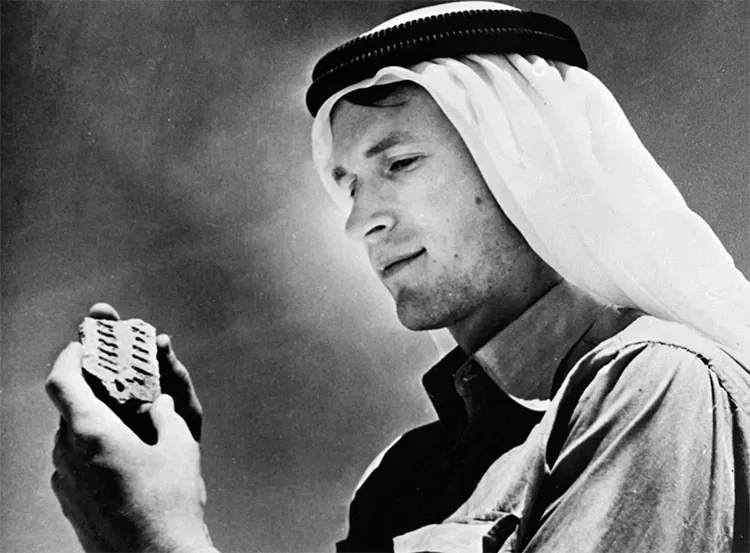
Wendell Phillips, 1952. Credit: HistoryToday.com
Scheherazade didn't just whisper to Englishmen; she whispered to Americans, as well. In the late 1940s, an adventurer named Wendell Phillips organized a series of archaeological expeditions to find traces of Ali Baba and Sinbad. He became both famous and rich; admirers called him "the American Lawrence of Arabia."
I had never heard of Wendell Phillips until one morning when I passed a poster while crossing Sproul Plaza. I had just returned from Cairo and morphed from a dashing hero to a drudging graduate student on my way to a get a bagel. I stopped, dumbfounded. A man in a Lawrence of Arabia costume, complete with dagger, stared happily at me. I rubbed my eyes: He looked like Lawrance, but he wasn't, and he had what could only be described as a "shit-eating grin." After a moment of stunned silence, I went on to class, a dreary session in Arabic syntax. After class, I sprinted to the department chairman's office.
"Who is the guy on the poster?" I demanded.
The chairman grinned and said, "That is Wendell Phillips, Berkeley's most famous graduate. He is speaking tonight; you have to go." He waved me out. "I will be on the platform, but because Philip's people don't like me, they'll make me sit at the end of the row. Look for me behind the curtain."
So, that evening, I trundled to the auditorium.
It was packed; the first two rows of seats were filled with clerics. A row of chairs lined the stage, and the chairman sat at one end. A small man in a brown suit took the mike. "I am Wendell Phillipps, and I'm here to tell you about my book, Qataban and Sheba." Well, at least there was no shaykh suit. The first two rows stood and clapped. "But first, let me introduce my archaeological team—the men who made my book possible." And one by one, he introduced them (except for the chairman, who just sat there). "Meet the world's greatest artefact digger." (Applause.) "I give you the world's greatest artefact duster." (Applause.) "Finally, here is the world's greatest Land Rover driver." (More applause.)
Having introduced all these masters of their craft, Wendell turned to his mother and wife. "Let me introduce my mother, Sunshine, motorcycle hill-climb champion of Colorado." (Applause.) "Stand up, Mom." A gray-haired woman stood up a couple of rows from me. "And now, my wife, the hula-hoop champion of Hawaii." A dark-haired woman stood up. Wendell laughed. "It's not true that she put on boots and kicked me out of bed on our wedding night." (Laughter.)
The chairman hid a smile behind his hand; I just sat there with my jaw hanging open.
Phillips stopped and looked around breathlessly. A cleric in the front row stood up and gestured for silence. "Ladies and gentlemen, let's hear it for Wendell Phillips, the world's greatest man." (Thunderous applause and stomping.) Somehow, I knew this was coming.
Then on to the show, and it was mind-boggling: slide after slide of stuff I had only read about in books. First up was a photo of the Ma'rib dam, a giant earthwork stretching from horizon to horizon. Construction started around 2000 BC near the city of Ma'rib, capital of the ancient Kingdom of Sheba (known as Saba in ancient texts). Sheba was green, not the desert that Yemen is today, and was famous for the export of frankincense and myrrh. Irrigation was made possible by damming up a huge lake between two mountains and constructing a series of canals. Civilization flourished: coin hoards indicate that Shebans traded with the ancient world, in the Middle East (think Moses and the Queen of Sheba), Europe, and Central Asia. Sheba was at one point the end of the "Silk Road." And there is a theory that “the black Irish” are descendants of Sheban merchants who travelled to ancient Ireland.
But the dam was destroyed in the late 5th century AD, and Yemen turned back into a desert. The resulting collapse of civil society in the region is known as the "jahiliyyah," the period of ignorance. The Koran contrasts it with the order created by Islam.
Amazing.
But there was a lot more. "Now, ladies and gentlemen, I will show you our discoveries at the temple of the Queen of Sheba." And up came a photo of a Greek-style temple of enormous proportions. Slide after slide followed: some showed Greek and Roman coins, minted evidence of far-reaching trade; others showed gold statues, an archeological treasure trove rivalling that found in King Tut's tomb.
So, what happened to all these discoveries?
"Alas," said Phillips, "we were forced to leave by the Imam of Yemen. His men harassed us until I feared for the safety of the expedition." He frowned; the audience booed. "We lost everything."
Now, I happened to have read some anecdotes about Iman Yahya: Legend had it that he would wrap a bow-string around his throat and tighten it to make his eyes bulge and appear more threatening. Another story says that in his eighties, while he was in a hospital, he was shot by an assassin; he promptly jumped out of bed and personally dispatched the unlucky assailant. Definitely not a man to be trifled with.
Wendell was right, time to leave.
Finally, the show was over. The clerics filed out to two large buses, and the crowd disbursed, burbling to themselves. I left, "feeling desolated," as the song from Kismet goes. The next morning, I stormed into the library stacks and checked out Qataban and Sheba. It was all true; the photographs were impressive. Clearly, Phillips had made a major archeological discovery. I read further—Wait, this guy was in Cairo while his expedition was being attacked. What goes on here? Time to talk to the chairman again.
As my grandfather would say, tune in next time.
